
Beyond the Spreadsheet: A Smarter Way to Schedule Large-Scale Training
Large-scale transformation programs are complicated enough without training becoming a logistical puzzle. For organizations rolling out a major ERP or digital transformation, training can involve thousands of employees, dozens of locations, hundreds of roles and courses, multiple instructors, facilities, prerequisites, work schedules, travel constraints and individual availability. And that’s before anything changes. Yet much of this complexity is still managed in spreadsheets.
A training team can spend weeks building an intricate schedule in Excel, only to have a site change its availability, an instructor call in sick, a learner’s role change or, perhaps most painful, a go-live date move. Suddenly, an already complicated schedule becomes a massive exercise in reshuffling people, rooms, instructors, and courses.
Turning a Training Puzzle into a Manageable Process
Drawing on 30 years of experience in training and change management, Alex Rose, enterprise transformation leader, developed a new training scheduling tool, Veritable Scheduler, specifically designed to solve these challenges. At its core is intelligent deconfliction logic that continuously considers the many variables involved in large-scale training. Instead of asking training teams to manually identify conflicts, the application filters available options and helps build schedules while accounting for learners, instructors, rooms, locations, roles, courses, prerequisites and scheduling constraints.
Training teams can work interactively, using an Object-based Scheduler to drag and drop training into a schedule while the application identifies potential conflicts behind the scenes. Or, when speed and scale are the priority, an Auto Scheduler can build the schedule automatically based on defined parameters, eliminating much of the manual work required to schedule large populations.
That flexibility matters. Teams can determine whether training should be concentrated as efficiently as possible or spread out to give employees and instructors more breathing room. They can establish limits around training hours, consecutive training days and other workload considerations, helping ensure employees can continue doing their jobs while completing required training. And when something inevitably changes, a site becomes unavailable, an instructor needs to be replaced or the go-live date moves, the schedule can be adjusted without starting over.
Visibility That Goes Beyond the Spreadsheet
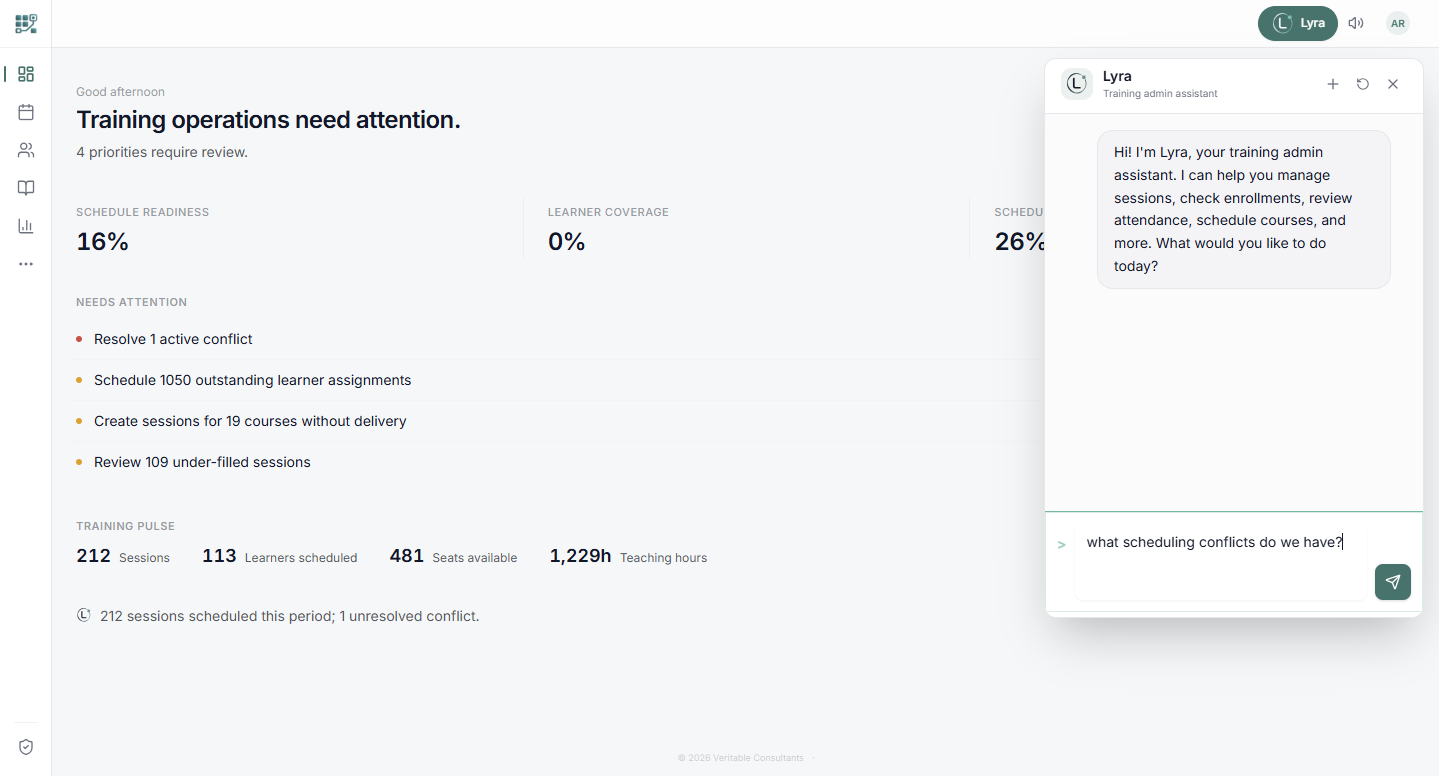
One of the biggest advantages of Veritable Scheduler isn't simply creating the schedule; it’s knowing where the schedule stands. A scheduling command center provides visibility into:
Roles
Courses
Learning paths
Instructors
Rooms
Available seats
Overall scheduling progress
Under or overutilization of instructors and rooms
Unscheduled learners
Courses without sessions
Active conflicts
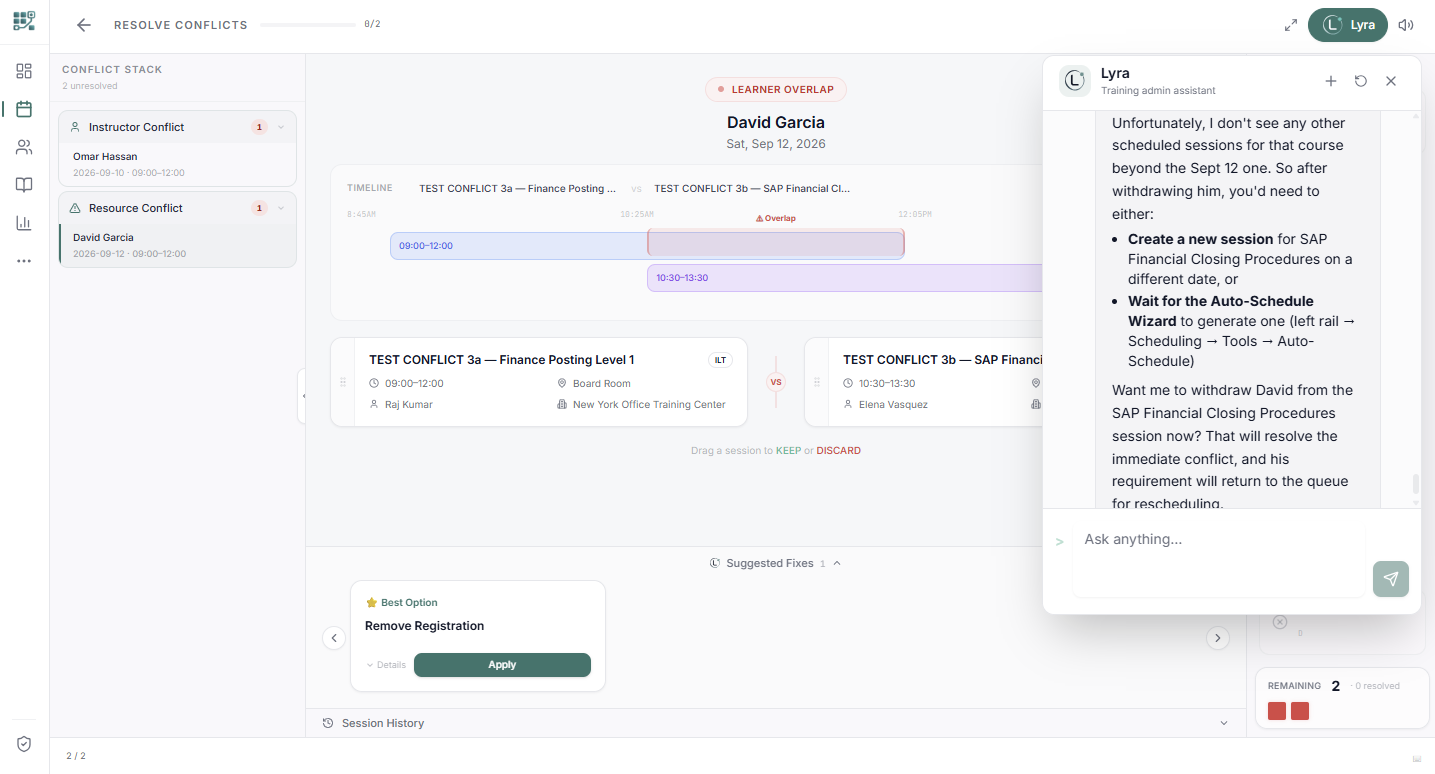
Instead of asking multiple people to review an Excel spreadsheet looking for errors, the dashboard surfaces them. When a conflict does occur, users can drill into the issue and resolve it directly, helping eliminate the ripple effect that often occurs when one scheduling change creates another problem somewhere else. The result is more than convenience. It can reduce wasted time, prevent avoidable disruptions, and help training teams execute large programs with greater confidence.
Who is it for?
The sweet spot for Veritable Scheduler is large-scale corporate transformation programs with significant training components, particularly implementations involving large employee populations, multiple sites, complex role-based curriculum and numerous training resources. Think ERP implementations, major technology transformations and other enterprise changes where thousands of employees must be trained before go-live. The tool can also import and export core training data, including users, roles, courses, instructors, sites and schedules, and can support LMS-compatible exports, making it easier to fit into an organization's existing training ecosystem.
A New Opportunity for Change and Training Leaders
For change management and training professionals, the Veritable Scheduler tool represents something bigger than better training scheduling. Our job isn't simply to design communications or training; it's to remove barriers to adoption and make change easier for the people experiencing it.
When employees show up for training and the instructor isn't there, the room is unavailable or the schedule doesn't align with their work responsibilities, those seemingly small issues create friction. Multiply that across thousands of employees and dozens of locations, and the impact can become significant.
Better training logistics won't solve every adoption challenge, but it can remove an unnecessary one. For training leaders, it means less time wrestling with spreadsheets and more time focused on learning effectiveness. For change leaders, it provides another way to reduce disruption and help the organization move toward go-live with fewer training-related disruptions and greater confidence. The best change experiences aren't just well-designed, they're well-executed. And sometimes, making change easier starts with getting the logistics right.
Contact ChangeStaffing to help your organization develop and deliver the training support needed for successful, sustainable change. Special thanks to Alex Rose, enterprise transformation leader and Veritable Scheduler developer, for his thought leadership and collaboration on this blog. Written by Kylette Harrison.